Introducing F.C. Badges collection by C.7 Design Studio,
celebrating the diverse and exciting world of football (or soccer, if you
wish), and its heraldry in particular, which found its home on FineArt America.
Each piece of the collections features a club badge created using my unique
2.5D method of digital painting, accompanied by vintage logo and flag backdrops.
This is a work in progress, so, stay tuned for updates.
Pop art? Not quite... Rather - the art of making things pop... Introducing unique and visually stunning fine art pieces by Serge Averbukh (C.7 Design Studio).Toronto-based artist/designer/illustrator, specializing primarily in heraldry, yet constantly and passionately creating in various media such as digital art, photography and mixed media arts.
Thursday, January 29, 2015
FC Badges Fine Art
Monday, January 26, 2015
Fine Art: Vintage Patents & Blueprints
Introducing Vintage Patents and Blueprints collection by C.7 Design Studio, showcasing meticulous digital reproductions of historical patent and blueprint documents, digitally enhanced and transformed into large format prints, stylized to preserve look and feel of various mediums, accompanied by stunning 2.5D elements. Nowadays, fine art market is flooded with patent reproductions. Most of them just simple blown up copies of patents found via Google search and slapped on colorful backgrounds. Entering this market niche, I was thinking what could be done differently. So, I took entirely new approach. I didn’t bother using Google to search for patents, but rather went straight to the source - the digitized archives of The United States Patent and Trademark Office. Although my process of sifting through thousands upon thousands of patent scans was tenfold more time-consuming, it yielded far better results, netting me some of those rear gems of huge importance, which would have been missed otherwise, should I just resorted to Google search for what comes to mind. I also use my proprietary enlargement and enhancements processes, which helped me to achieve unparalleled quality, unique vintage look and 2.5D feel of raised inks. And last, but not least - each patent was adorned by realistically-looking crest and wax seal of The United States Patent and Trademark Office. The results speak for themself. At this point I have three major collections going - the “Historical Patents”, which includes miscellaneous assembly of most significant or historically-important patents; the “Sports Patents”, which houses greatest inventions in the world of sports, and the “Weapons & Firearms” collection, following history of weapons and firearms development. There will be more collections to come, so, stay tuned. Below are a few samples from each of the collections.
I have chosen FineArt America to offer my digitally-signed and dated open edition (OE) fine art giclée prints of highest archival quality. Many of these pieces are exclusive to FAA. The hand-signed special collector's AP editions are also available (please, contact me for details). Commissions are welcome (as time permits). Make sure to visit FineArt America for wide selection of historical patents art, sports patents art such as baseball or golf, and weaponry-related patents art. Please, feel free to drop me a line should you have any questions or comments.
Sunday, January 25, 2015
Treasure Trove Fine Art Prints
Introducing Treasure Trove collection by C.7 Design Studio, showcasing original digital paintings as well as reproductions inspired by modern and historical masterpieces, artifacts and other priceless treasures of human history.
Celtic Tree of Life. In Egypt the Acacia tree of Saosis was considered the "tree of life", referring to it as the "tree in which life and death are enclosed". References to The Tree of Life can be found in ancient Assyria, China, as well as in Germanic paganism and Norse mythology, Judaism, Kabbalah, Christianity, Vedic texts of India, sources from Urartu and Mesoamerica.
In Norse mythology it is also known as Yggdrasil, an immense tree that is central in Norse cosmology. It was said to be the world tree around which the nine worlds existed. Its name is generally considered to mean "Ygg's (Odin's) horse". Yggdrasil is attested in the Poetic Edda, compiled in the 13th century from earlier traditional sources, and the Prose Edda, written in the 13th century by Snorri Sturluson. In both sources, Yggdrasil is an immense ash tree that is central and considered very holy. The gods go to Yggdrasil daily to hold their courts. The branches of Yggdrasil extend far into the heavens, and the tree is supported by three roots that extend far away into other locations; one to the well Urðarbrunnr in the heavens, one to the spring Hvergelmir, and another to the well Mímisbrunnr. Creatures live within Yggdrasil, including the wyrm (dragon) Níðhöggr, an unnamed eagle, and the stags Dáinn, Dvalinn, Duneyrr and Duraþrór.
Tribute to Katsushika Hokusai - Shoki Riding Shishi Lion also known as Samurai Riding a Lion on Red.
Katsushika Hokusai (葛飾 北斎), October 31, 1760 (exact date questionable) – May 10, 1849) was a Japanese artist, ukiyo-e painter and printmaker of the Edo period. He was influenced by such painters as Sesshu, and other styles of Chinese painting. Born in Edo (now Tokyo), Hokusai is best known as author of the woodblock print series Thirty-six Views of Mount Fuji (富嶽三十六景 Fugaku Sanjūroku-kei, c. 1831) which includes the internationally recognized print, The Great Wave off Kanagawa, created during the 1820s.
Hokusai created the "Thirty-Six Views" both as a response to a domestic travel boom and as part of a personal obsession with Mount Fuji. It was this series, specifically The Great Wave print and Fuji in Clear Weather, that secured Hokusai’s fame both in Japan and overseas. As historian Richard Lane concludes, "Indeed, if there is one work that made Hokusai's name, both in Japan and abroad, it must be this monumental print-series...". While Hokusai's work prior to this series is certainly important, it was not until this series that he gained broad recognition.
Ukiyo-e, or ukiyo-ye (浮世絵; "pictures of the floating world"), is a genre of woodblock prints and paintings that flourished in Japan from the 17th through 19th centuries. Aimed at the prosperous merchant class in the urbanizing Edo period (1603–1867), depictions of beautiful women; kabuki actors and sumo wrestlers; scenes from history and folk tales; travel scenes and landscapes; flora and fauna were amongst the popular themes.
Golden Chinese Dragon Fucanglong (伏藏龙) with Magic Pearl on Rice Paper.
A dragon is a legendary creature, typically with serpentine or reptilian traits, that features in the myths of many cultures. There are two distinct cultural traditions of dragons: the European dragon, derived from European folk traditions and ultimately related to Greek and Middle Eastern mythologies, and the Chinese dragon, with counterparts in Japan (namely the Japanese dragon), Korea and other East Asian countries. The two traditions may have evolved separately, but have influenced each other to a certain extent, particularly with the cross-cultural contact of recent centuries. The English word "dragon" derives from Greek δράκων (drákōn), "dragon, serpent of huge size, water-snake".
Chinese dragons are legendary creatures in Chinese mythology and Chinese folklore. The dragons have many animal-like forms such as turtles, fish, and imaginary creatures, but they are most commonly depicted as snake-like with four legs. In yin and yang terminology, a dragon is yang and complements a yin fenghuang ("Chinese phoenix").
Chinese dragons traditionally symbolize potent and auspicious powers, particularly control over water, rainfall, hurricane, and floods. The dragon is also a symbol of power, strength, and good luck for people who are worthy of it. With this, the Emperor of China usually used the dragon as a symbol of his imperial power and strength.
In Chinese daily language, excellent and outstanding people are compared to a dragon, while incapable people with no achievements are compared with other, disesteemed creatures, such as a worm. A number of Chinese proverbs and idioms feature references to a dragon, for example: "Hoping one's son will become a dragon" (望子成龍, i.e. be as a dragon). In Chinese mythology the Fucanglong (simplified Chinese: 伏藏龙; traditional Chinese: 伏藏龍; pinyin: Fúcánglóng) or Fu-ts'ang-Lung (Wade-Giles) is the Chinese underworld dragon which guard buried treasures, both natural and man-made. Volcanoes are said to be created when they burst out of the ground to report to heaven. Futs-lung possesses a magic pearl which is his most treasured possession.
Tibetan Double Dorje Mandala - Double Vajra. Vajra (Devanagari: वज्र; Bengali: বজ্র bojro, Tibetan: རྡོ་རྗེ། dorje; Dzongkha: dorji; Indonesian wajra; Chinese: 金剛 jīngāng; Korean: 금강저 geumgangjeo; Japanese: 金剛杵 kongōsho; Mongolian: Очир ochir or Базар Bazar) is a Sanskrit word meaning both thunderbolt and diamond. It is also a common male name in Tibet and Bhutan. Additionally, it is a weapon which is used as a ritual object to symbolize both the properties of a diamond (indestructibility) and a thunderbolt (irresistible force). The vajra is essentially a type of club or mace with a ribbed spherical head. The ribs may meet in a ball-shaped top, or they may be separate and end in sharp points with which to stab. The ritual vajra is a much smaller hand-held object with two heads, one on each end of the handle. The vajra is used symbolically by the dharma traditions of Buddhism, Jainism and Hinduism, often to represent firmness of spirit and spiritual power. The use of the vajra as a symbolic and ritual tool spread from India along with Indian religion and culture to other parts of East and Southeast Asia...
Sacred Silver Griffin. The griffin, griffon, or gryphon (Greek: γρύφων, grýphōn, or γρύπων, grýpōn, early form γρύψ, grýps; Latin: gryphus) is a legendary creature with the body, tail, and back legs of a lion; the head and wings of an eagle; and an eagle's talons as its front feet. Because the lion was traditionally considered the king of the beasts and the eagle the king of birds, the griffin was thought to be an especially powerful and majestic creature. The griffin was also thought of as king of all creatures. Griffins are known for guarding treasure and priceless possessions. Adrienne Mayor, a classical folklorist, proposes that the griffin was an ancient misconception derived from the fossilized remains of the Protoceratops found in gold mines in the Altai mountains of Scythia, in present day southeastern Kazakhstan, or in Mongolia. In antiquity it was a symbol of divine power and a guardian of the divine. Some have suggested that the word griffin is cognate with Cherub.
Celtic Treasures - Three Dogs. The Celts or Kelts were an ethnolinguistic group of tribal societies in Iron Age and Medieval Europe who spoke Celtic languages and had a similar culture, although the relationship between the ethnic, linguistic and cultural elements remains uncertain and controversial.
The earliest archaeological culture that may justifiably be considered Proto-Celtic is the Late Bronze Age Urnfield culture of Central Europe, which flourished from around 1200 BC. Their fully Celtic descendants in central Europe were the people of the Iron Age Hallstatt culture (c. 800–450 BC) named for the rich grave finds in Hallstatt, Austria. By the later La Tène period (c. 450 BC up to the Roman conquest), this Celtic culture had expanded by diffusion or migration to the British Isles (Insular Celts), France and The Low Countries (Gauls), Bohemia, Poland and much of Central Europe, the Iberian Peninsula (Celtiberians, Celtici and Gallaeci) and northern Italy (Golaseccans and Cisalpine Gauls) and, following the Gallic invasion of the Balkans in 279 BC, as far east as central Anatolia (Galatians). By the mid 1st millennium AD, with the expansion of the Roman Empire and the Great Migrations (Migration Period) of Germanic peoples, Celtic culture and Insular Celtic had become restricted to Ireland, the western and northern parts of Great Britain (Wales, Scotland, and Cornwall), the Isle of Man, and Brittany. Between the 5th and 8th centuries, the Celtic-speaking communities in these Atlantic regions emerged as a reasonably cohesive cultural entity. They had a common linguistic, religious, and artistic heritage that distinguished them from the culture of the surrounding polities. By the 6th century, however, the Continental Celtic languages were no longer in wide use.
Insular Celtic culture diversified into that of the Gaels (Irish, Scottish and Manx) and the Brythonic Celts (Welsh, Cornish, and Bretons) of the medieval and modern periods. A modern "Celtic identity" was constructed as part of the Romanticist Celtic Revival in Great Britain, Ireland, and other European territories, such as Portugal and Spanish Galicia. Today, Irish, Scottish Gaelic, Welsh, and Breton are still spoken in parts of their historical territories, and Cornish and Manx are undergoing a revival.
Icelandic Dragon – one of the four great guardians who are known as the four landvættir.
The Old Norse kings' sagas, more specifically Heimskringla, tell the story of a seafarer who sailed to Iceland in ancient times. When he reached Vopnafjörður, he saw an enormous dragon who guarded the bay, and drove everybody away with fire. The dragon was followed by a great number of lizards and insects.
This dragon was one of the four mythical landvættir, guardians of Iceland. The dragon has become the icon of Vopnafjörður, and is pictured on the Coat of arms of Iceland.
I have chosen FineArt America to offer my digitally-signed and dated open edition (OE) fine art giclée prints of highest archival quality. Many of these pieces are exclusive to FAA. The hand-signed special collector's AP editions are also available (please, contact me for details). Commissions are welcome (as time permits). FineArt America has extensive selection of Celtic Art, Chinese art, Japanese art, Tibetan art, Icelandic art, and multitude of other sacred symbols art for you to choose from. Please, feel free to drop me a line should you have any questions or comments.
Celtic Tree of Life. In Egypt the Acacia tree of Saosis was considered the "tree of life", referring to it as the "tree in which life and death are enclosed". References to The Tree of Life can be found in ancient Assyria, China, as well as in Germanic paganism and Norse mythology, Judaism, Kabbalah, Christianity, Vedic texts of India, sources from Urartu and Mesoamerica.
In Norse mythology it is also known as Yggdrasil, an immense tree that is central in Norse cosmology. It was said to be the world tree around which the nine worlds existed. Its name is generally considered to mean "Ygg's (Odin's) horse". Yggdrasil is attested in the Poetic Edda, compiled in the 13th century from earlier traditional sources, and the Prose Edda, written in the 13th century by Snorri Sturluson. In both sources, Yggdrasil is an immense ash tree that is central and considered very holy. The gods go to Yggdrasil daily to hold their courts. The branches of Yggdrasil extend far into the heavens, and the tree is supported by three roots that extend far away into other locations; one to the well Urðarbrunnr in the heavens, one to the spring Hvergelmir, and another to the well Mímisbrunnr. Creatures live within Yggdrasil, including the wyrm (dragon) Níðhöggr, an unnamed eagle, and the stags Dáinn, Dvalinn, Duneyrr and Duraþrór.
Tribute to Katsushika Hokusai - Shoki Riding Shishi Lion also known as Samurai Riding a Lion on Red.
Katsushika Hokusai (葛飾 北斎), October 31, 1760 (exact date questionable) – May 10, 1849) was a Japanese artist, ukiyo-e painter and printmaker of the Edo period. He was influenced by such painters as Sesshu, and other styles of Chinese painting. Born in Edo (now Tokyo), Hokusai is best known as author of the woodblock print series Thirty-six Views of Mount Fuji (富嶽三十六景 Fugaku Sanjūroku-kei, c. 1831) which includes the internationally recognized print, The Great Wave off Kanagawa, created during the 1820s.
Hokusai created the "Thirty-Six Views" both as a response to a domestic travel boom and as part of a personal obsession with Mount Fuji. It was this series, specifically The Great Wave print and Fuji in Clear Weather, that secured Hokusai’s fame both in Japan and overseas. As historian Richard Lane concludes, "Indeed, if there is one work that made Hokusai's name, both in Japan and abroad, it must be this monumental print-series...". While Hokusai's work prior to this series is certainly important, it was not until this series that he gained broad recognition.
Ukiyo-e, or ukiyo-ye (浮世絵; "pictures of the floating world"), is a genre of woodblock prints and paintings that flourished in Japan from the 17th through 19th centuries. Aimed at the prosperous merchant class in the urbanizing Edo period (1603–1867), depictions of beautiful women; kabuki actors and sumo wrestlers; scenes from history and folk tales; travel scenes and landscapes; flora and fauna were amongst the popular themes.
Golden Chinese Dragon Fucanglong (伏藏龙) with Magic Pearl on Rice Paper.
A dragon is a legendary creature, typically with serpentine or reptilian traits, that features in the myths of many cultures. There are two distinct cultural traditions of dragons: the European dragon, derived from European folk traditions and ultimately related to Greek and Middle Eastern mythologies, and the Chinese dragon, with counterparts in Japan (namely the Japanese dragon), Korea and other East Asian countries. The two traditions may have evolved separately, but have influenced each other to a certain extent, particularly with the cross-cultural contact of recent centuries. The English word "dragon" derives from Greek δράκων (drákōn), "dragon, serpent of huge size, water-snake".
Chinese dragons are legendary creatures in Chinese mythology and Chinese folklore. The dragons have many animal-like forms such as turtles, fish, and imaginary creatures, but they are most commonly depicted as snake-like with four legs. In yin and yang terminology, a dragon is yang and complements a yin fenghuang ("Chinese phoenix").
Chinese dragons traditionally symbolize potent and auspicious powers, particularly control over water, rainfall, hurricane, and floods. The dragon is also a symbol of power, strength, and good luck for people who are worthy of it. With this, the Emperor of China usually used the dragon as a symbol of his imperial power and strength.
In Chinese daily language, excellent and outstanding people are compared to a dragon, while incapable people with no achievements are compared with other, disesteemed creatures, such as a worm. A number of Chinese proverbs and idioms feature references to a dragon, for example: "Hoping one's son will become a dragon" (望子成龍, i.e. be as a dragon). In Chinese mythology the Fucanglong (simplified Chinese: 伏藏龙; traditional Chinese: 伏藏龍; pinyin: Fúcánglóng) or Fu-ts'ang-Lung (Wade-Giles) is the Chinese underworld dragon which guard buried treasures, both natural and man-made. Volcanoes are said to be created when they burst out of the ground to report to heaven. Futs-lung possesses a magic pearl which is his most treasured possession.
Tibetan Double Dorje Mandala - Double Vajra. Vajra (Devanagari: वज्र; Bengali: বজ্র bojro, Tibetan: རྡོ་རྗེ། dorje; Dzongkha: dorji; Indonesian wajra; Chinese: 金剛 jīngāng; Korean: 금강저 geumgangjeo; Japanese: 金剛杵 kongōsho; Mongolian: Очир ochir or Базар Bazar) is a Sanskrit word meaning both thunderbolt and diamond. It is also a common male name in Tibet and Bhutan. Additionally, it is a weapon which is used as a ritual object to symbolize both the properties of a diamond (indestructibility) and a thunderbolt (irresistible force). The vajra is essentially a type of club or mace with a ribbed spherical head. The ribs may meet in a ball-shaped top, or they may be separate and end in sharp points with which to stab. The ritual vajra is a much smaller hand-held object with two heads, one on each end of the handle. The vajra is used symbolically by the dharma traditions of Buddhism, Jainism and Hinduism, often to represent firmness of spirit and spiritual power. The use of the vajra as a symbolic and ritual tool spread from India along with Indian religion and culture to other parts of East and Southeast Asia...
Sacred Silver Griffin. The griffin, griffon, or gryphon (Greek: γρύφων, grýphōn, or γρύπων, grýpōn, early form γρύψ, grýps; Latin: gryphus) is a legendary creature with the body, tail, and back legs of a lion; the head and wings of an eagle; and an eagle's talons as its front feet. Because the lion was traditionally considered the king of the beasts and the eagle the king of birds, the griffin was thought to be an especially powerful and majestic creature. The griffin was also thought of as king of all creatures. Griffins are known for guarding treasure and priceless possessions. Adrienne Mayor, a classical folklorist, proposes that the griffin was an ancient misconception derived from the fossilized remains of the Protoceratops found in gold mines in the Altai mountains of Scythia, in present day southeastern Kazakhstan, or in Mongolia. In antiquity it was a symbol of divine power and a guardian of the divine. Some have suggested that the word griffin is cognate with Cherub.
Celtic Treasures - Three Dogs. The Celts or Kelts were an ethnolinguistic group of tribal societies in Iron Age and Medieval Europe who spoke Celtic languages and had a similar culture, although the relationship between the ethnic, linguistic and cultural elements remains uncertain and controversial.
The earliest archaeological culture that may justifiably be considered Proto-Celtic is the Late Bronze Age Urnfield culture of Central Europe, which flourished from around 1200 BC. Their fully Celtic descendants in central Europe were the people of the Iron Age Hallstatt culture (c. 800–450 BC) named for the rich grave finds in Hallstatt, Austria. By the later La Tène period (c. 450 BC up to the Roman conquest), this Celtic culture had expanded by diffusion or migration to the British Isles (Insular Celts), France and The Low Countries (Gauls), Bohemia, Poland and much of Central Europe, the Iberian Peninsula (Celtiberians, Celtici and Gallaeci) and northern Italy (Golaseccans and Cisalpine Gauls) and, following the Gallic invasion of the Balkans in 279 BC, as far east as central Anatolia (Galatians). By the mid 1st millennium AD, with the expansion of the Roman Empire and the Great Migrations (Migration Period) of Germanic peoples, Celtic culture and Insular Celtic had become restricted to Ireland, the western and northern parts of Great Britain (Wales, Scotland, and Cornwall), the Isle of Man, and Brittany. Between the 5th and 8th centuries, the Celtic-speaking communities in these Atlantic regions emerged as a reasonably cohesive cultural entity. They had a common linguistic, religious, and artistic heritage that distinguished them from the culture of the surrounding polities. By the 6th century, however, the Continental Celtic languages were no longer in wide use.
Insular Celtic culture diversified into that of the Gaels (Irish, Scottish and Manx) and the Brythonic Celts (Welsh, Cornish, and Bretons) of the medieval and modern periods. A modern "Celtic identity" was constructed as part of the Romanticist Celtic Revival in Great Britain, Ireland, and other European territories, such as Portugal and Spanish Galicia. Today, Irish, Scottish Gaelic, Welsh, and Breton are still spoken in parts of their historical territories, and Cornish and Manx are undergoing a revival.
Icelandic Dragon – one of the four great guardians who are known as the four landvættir.
The Old Norse kings' sagas, more specifically Heimskringla, tell the story of a seafarer who sailed to Iceland in ancient times. When he reached Vopnafjörður, he saw an enormous dragon who guarded the bay, and drove everybody away with fire. The dragon was followed by a great number of lizards and insects.
This dragon was one of the four mythical landvættir, guardians of Iceland. The dragon has become the icon of Vopnafjörður, and is pictured on the Coat of arms of Iceland.
I have chosen FineArt America to offer my digitally-signed and dated open edition (OE) fine art giclée prints of highest archival quality. Many of these pieces are exclusive to FAA. The hand-signed special collector's AP editions are also available (please, contact me for details). Commissions are welcome (as time permits). FineArt America has extensive selection of Celtic Art, Chinese art, Japanese art, Tibetan art, Icelandic art, and multitude of other sacred symbols art for you to choose from. Please, feel free to drop me a line should you have any questions or comments.
Wednesday, February 6, 2013
999.9: Creatures & Bones Collection
Introducing fine art framed and wrapped canvas prints from the "999.9: Creatures & Bones" collection by C.7 Design Studio. This collection features various beasts of this planet either in their live form, or in their skeletal and fossilized remains forms, performed in gold on dark vintage background. This series celebrates diversity of life and death, underlining how luxurious and precious the both forms of existence are and will always be.
This unique piece of original art will work well as stunning centerpiece complementing your new décor ideas, or as perfect accent for your already established interior. Being a perfect marriage of color harmony and flow of shape, this artwork will match and surpass the latest trends in interior design.
All prints are available in various sizes, including “colossal” prints up to 50”x50”, on a variety of premium canvasses. Below are some of the pieces form this collection...
This unique piece of original art will work well as stunning centerpiece complementing your new décor ideas, or as perfect accent for your already established interior. Being a perfect marriage of color harmony and flow of shape, this artwork will match and surpass the latest trends in interior design.
All prints are available in various sizes, including “colossal” prints up to 50”x50”, on a variety of premium canvasses. Below are some of the pieces form this collection...
Wednesday, January 23, 2013
Abstract Chic
Introducing framed (wrapped canvas) prints from the
"Abstract Chic" collection by C.7 Design Studio. These unique pieces
of original art will work well as stunning centerpiece complementing your new
décor ideas, or as perfect accent for your already established interior. Being
a perfect marriage of color harmony and flow of shape, this artwork will match
and surpass the latest trends in interior design. The artwork also incorporates
my M-LETT 2.5D technique.
All
the prints are available in various sizes, including “colossal” prints up to
50”x50”, on a variety of premium canvasses. Custom frames and variety of high
quality archival paper are also available. Zazzle's gloss canvas is made from a
tight weave, acid-free cotton-poly blend canvas ideal for photography or art.
Printed with a special ink-receptive coating, your wrapped canvas print will be
fade-resistant for 75 years. All the prints presented here are available for purchase from my
"Prints" gallery on Zazzle.
Labels:
2.5D,
Abstract Chic,
Blue Moon,
c7 3D hi res framed prints,
c7 design 3D,
c7 design gifts,
Coffee Dream,
Comfort Zone,
fine art,
modern art,
Ocean Breeze,
original art,
pop art,
wrapped canvas
Saturday, November 3, 2012
Anubis & Nut
One of the ongoing projects, which is heavily influenced by my MLETT-3D method is “Sacred Symbols 3D” Collection. Today I am introducing a series of unique framed prints, featuring
Egyptian goddess Nut, alternatively spelled Nuit, Newet, and Neuth – The Sky
Goddess, and Egyptian jackal-headed god Anubis, also known as Inpu, Anup, Anpu, and
Ienpw.
Nut was the goddess of the sky and all heavenly bodies, a symbol of
protecting the dead when they enter the afterlife. According to the Egyptians,
during the day, the heavenly bodies—such as the sun and moon—would make their
way across her body. Then, at dusk, they would be swallowed, pass through her
belly during the night, and be reborn at dawn.Nut is also the barrier separating the forces of chaos from
the ordered cosmos in the world. Because of her role in saving Osiris, Nut was
seen as a friend and protector of the dead.
Anubis was associated with the mummification and protection
of the dead for their journey into the afterlife. One of the roles of Anubis was
"Guardian of the Scales". Deciding the weight of "truth" by
weighing the Heart against Ma'at, who was often depicted as an ostrich feather,
Anubis dictated the fate of souls. In this manner, he was a Lord of the
Underworld, only usurped by Osiris. All the prints presented here, as well as a variety of custom products with this design are available for purchase from my "Sacred Symbols" galleries on Zazzle.
Labels:
Anpu,
Anubis,
Anup,
c7 3D hi res framed prints,
c7 design gifts,
c7 sacred symbols 3D,
Egyptian amulets,
Ienpw,
Inpu,
jackal god,
Lord of the Underworld,
Neuth,
Newet,
Nuit,
Nut,
sky goddess,
symbol of afterlife
Saturday, September 29, 2012
3D, or not 2D?

And then it suddenly dawned on me: what if, somehow, I was
able to create a new graphic realm, sort of a love child born out of an
unorthodox union of 2D-father and 3D-mother (WOW!), utilizing the best of
both worlds? In technical terms, it would possess simplicity, portability and
light-weightiness of 2D, at the same time, having stunning look, feel and
texture of 3D… Is it even possible, one would ask? Well, I wasn't really sure
at the time, but I thought I'd give it a try.


After some research, I have discovered that a few terms somewhat describing this type of imaging technology have already been coined. 2.5D ("two-and-a-half-dimensional"), 3/4 perspective and pseudo-3D are terms, used mainly in the video game industry to describe among other things, a 2D graphical projections and similar techniques, which are used to cause a series of images (or scenes) to simulate the appearance of being three-dimensional (3D) when in fact they are not, or gameplay in an otherwise three-dimensional video game that is restricted to a two-dimensional plane.

What also helped me a lot on this path of discovery is the fact that I did not have any formal education in the area of graphic design. Zero. Then, quite a while ago, I discovered Adobe Photoshop, and fell in love at first sight. My teachers were renowned Photoshop gurus such as Bert Monroy, always encouraging playing, experiment and working "out of the box". Versatility and virtually unlimited possibilities of Photoshop, combined with my curiosity and strong knack for experimentation, resulted in what I later called M-LETT 3D (or M-LETT 2.5D, in its latest incarnation) method (short for "Multi-Layer Enhancement & Texturing Technique").


After some research, I have discovered that a few terms somewhat describing this type of imaging technology have already been coined. 2.5D ("two-and-a-half-dimensional"), 3/4 perspective and pseudo-3D are terms, used mainly in the video game industry to describe among other things, a 2D graphical projections and similar techniques, which are used to cause a series of images (or scenes) to simulate the appearance of being three-dimensional (3D) when in fact they are not, or gameplay in an otherwise three-dimensional video game that is restricted to a two-dimensional plane.

What also helped me a lot on this path of discovery is the fact that I did not have any formal education in the area of graphic design. Zero. Then, quite a while ago, I discovered Adobe Photoshop, and fell in love at first sight. My teachers were renowned Photoshop gurus such as Bert Monroy, always encouraging playing, experiment and working "out of the box". Versatility and virtually unlimited possibilities of Photoshop, combined with my curiosity and strong knack for experimentation, resulted in what I later called M-LETT 3D (or M-LETT 2.5D, in its latest incarnation) method (short for "Multi-Layer Enhancement & Texturing Technique").
The idea was fairly simple. I asked myself: what makes
things look 3-dimensional and realistic? Technically speaking, just a few
components: perspective, light/shadow and texture. So, how would you make
things pop without employing actual 3D-rendering technology (a process of
automatically converting 3D wire frame models into 2D images with 3D
photorealistic effects or non-photorealistic rendering on a computer)?
Basically, how would you fake 3D? Photoshop already had almost everything I
needed in its arsenal, and the best possible solution was to utilize the
amazing and powerful set of features called ”layer styles". Now all
I needed was to assemble a toolkit appropriate for the task, as well as some
innovative ways of using it. Another important part of the equation was
to incorporate various textures, such as various metals, enamels, precious
stones, leathers and fabrics into my toolbox.
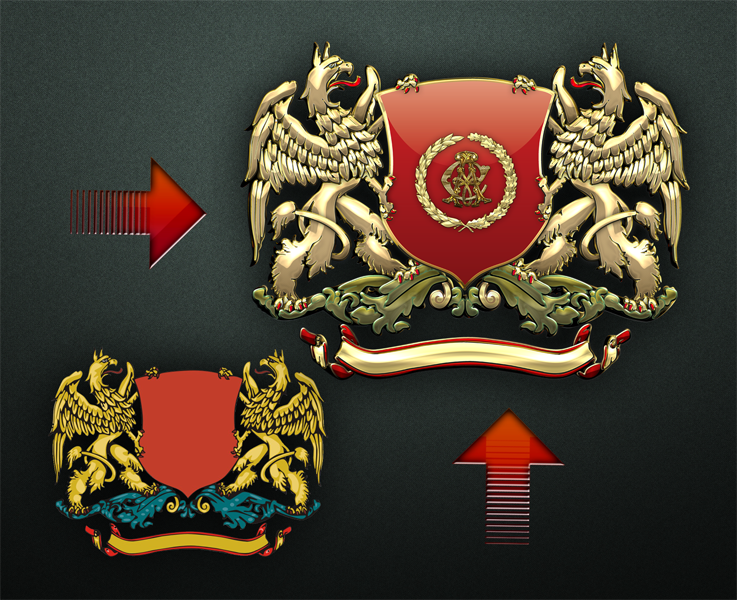
So, how is it actually done? In a nutshell, here
is how… You start with a regular flat two-dimensional image. I normally create
it in a form of a vector image in Adobe Illustrator, or use a pre-existing
vector or raster image, which I then vectorize. Next step is sort of a
reverse-engineering process of the said 2D image, performed in Photoshop. I literally
disassemble the base 2D image into multiple layers, positioning them as they
would appear if it was a three-dimensional object. Every little detail counts.
You may not even acknowledge it, but your brain will. As soon as all the layers
are stacked up and ready, each layer and each detail would get its
individual style-texture-shadow/light treatment. All elements come together in
a final draft, which pops and comes to life in a very visually-impressive and
an unusual way. All my images are results of a very detailed and time-consuming
process. And the process turned out to be a never ending work-in-progress
to this day. I have to admit though -- it's a lot of fun...
At this point, my
lifelong interest in heraldry and insignia came into play. I realized that my
task would be more feasible when dealing with generally flat objects with
moderately-raised reliefs, such as coins, pins or various insignia. While
researching the topic, I noticed how flat and plain the majority of such
imagery used by webmasters, in print
production and manufacturing were . A
new idea started boiling alongside my Photoshop quest. What if I combine my
newly-born "fake 3D" method with the idea of enhancing various
heraldry and insignia objects, bringing them to life, so to speak, making them
stand out and look realistic? This is how some of my major-scale projects ,
such as "Military Insignia 3D", "World heraldry 3D" and
"Sacred Symbols 3D" were born.
I am following those in detail on my other blogs, as well as on my
"Heraldry Workshop" blog. This
particular blog will simply be a showcase of my artwork and ever-evolving
M-LETT 3D method, not covered on my other blogs. Welcome to the new realm of 3D that is not
really a 3D, or, if you wish, a 2D, which doesn't look like it normally
would... Hopefully, together we can
answer the question: 3D or not 2D?
Subscribe to:
Posts (Atom)